
Three sets of eyes land on every film before it ships, and that triple quality control is what gets pulled apart here: the editor, then an editing team leader, then a manager. The team leader’s checklist is spelled out, technical specs, audio, color, music choice, and storyline checked against the client’s sample films, alongside the weekly training a Chief Editor runs. Reassurance for videographers vetting whether a partner’s process is rigorous enough.
One of the key distinctions between Bride&Groom.video and other wedding video editing companies lies in our triple quality control and focus on continuous team training. We believe that it aids in refining each video down to its last pixel, ensuring that the final product delivered to couples both truly captures the essence of their once-in-a-lifetime event and is in line with our client videographer’s style.
Triple Quality Control
Triple quality control means that each film undergoes a meticulous three-tiered review process prior to being delivered to the client: by an editor, an editing team leader, and a manager.
At the initial level, a manager diligently addresses the client’s requirements and preferences, meticulously scrutinizing the final video to confirm the fulfillment of all desired elements. Our managers also ensure that we have received all footage for the project (a warm greeting to all who have experienced the agony of transferring hundreds of files, amounting to hundreds of gigabytes 😅).
Upon completing their work, the video editor always takes a brief hiatus of a few hours to approach the result with a fresh perspective. Subsequently, they render the project and submit it to their editing team leader for review.
Quality Control Checklist
Within our organizational structure, we have five editing team leaders who bear the responsibility for maintaining the quality of their small teams comprising 6-10 editors. Once a team member completes a project, they conduct a thorough review utilizing a comprehensive checklist:
- Checking technical aspects. It all begins with the team leader receiving the film from the editor. They meticulously examine things such as the aspect ratio, fps, adherence to the checklist, implementation of visual effects, consistency of titles, and overall video duration.
- Checking the audio. Our team has sound engineers who ensure that the audio processing receives the utmost attention, adhering to our quality standards.
- Reviewing color correction. Color correction plays a pivotal role in elevating the final video. To ensure precise evaluation of color correction, our team leaders rely on professional devices like Apple monitors or other industry-standard solutions, guaranteeing that the video achieves the desired visual aesthetics.
- Reviewing the music selection in the project. If the music is provided by the client, no additional checks are required. However, when sourcing music from platforms like Musicbed or TrackClub, the editing team leader carefully considers the style of music outlined in the checklist or shared examples from the client. We strive to find a seamless match while infusing a creative touch tailored to each unique project.
- Checking the storyline and ensuring alignment with the client’s preferences, relying on three examples of their previous work. Prior to the review process, a team leader examines three sample videos, conducting a comprehensive analysis. This analysis serves as a foundation for reviewing the final edited video. Should any observations or revisions be necessary, the team leader provides feedback through Frame.io, collaboratively working with the editor to refine and capture the subtleties that make the story come alive in the video.
After receiving the green light from them all, the project is passed on to the videographer for review, with the added benefit of two rounds of revisions already factored into the project cost. What truly fills us with pride is that with each passing year, a growing number of clients approve their projects with just one round of revisions or even without requiring any revisions at all.
Continuous Team Training
Our robust quality control enables us to closely monitor the output quality of our work. However, what honestly sets us apart is our unwavering commitment to continuous training and knowledge sharing among our video editors.
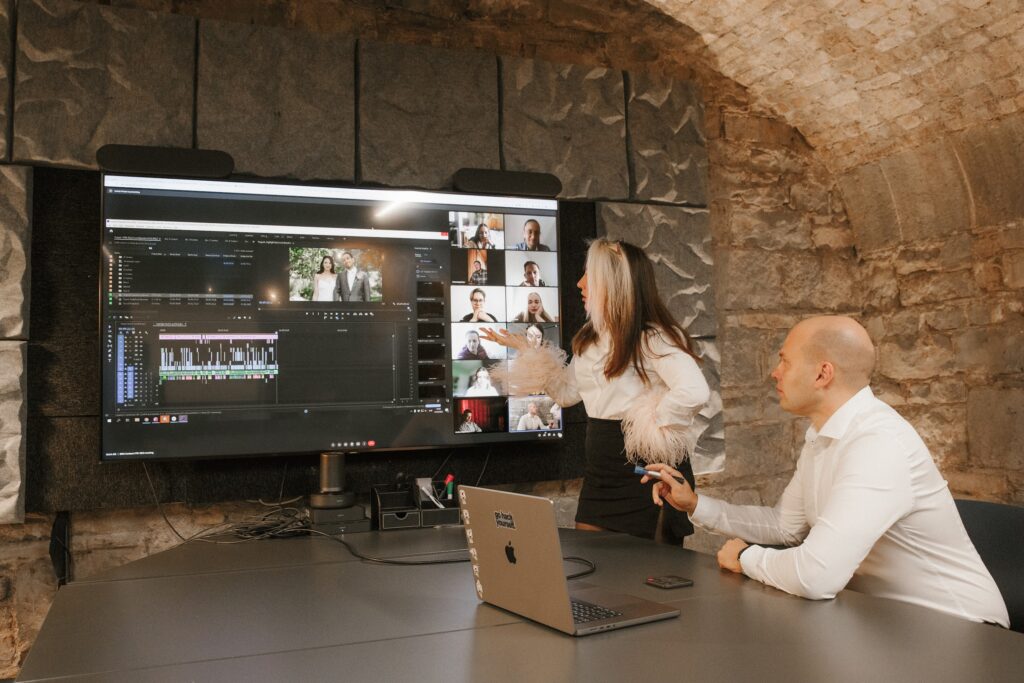
In our company, we have a specialized position known as the Chief Editor, who plays a pivotal role in studying global trends in wedding videography and video editing, testing cutting-edge tools, and providing ongoing education to our team. Collaborating with the Editing Team Leads, they conduct regular training every Friday, empowering our video editors to elevate their skills, leverage innovative tools effectively, and streamline project timelines.
Are you a wedding videographer who hasn’t yet taken advantage of outsourcing your editing to Bride&Groom.video? Now is the ideal moment to get started! Complete the form below, and rest assured, you’ll be thoroughly satisfied!
—
FAQs
What if I’m still unhappy after all three internal reviews?
The internal checks aren’t the end of the process; your own review comes next, with two rounds of revisions already factored into the project cost. In practice, the article notes a growing share of clients approve with one round or none, but the revision rounds exist precisely for the cases where something needs adjusting after the team’s sign-off.
I’m new and don’t have three previous films to share. Can my style still be matched?
The three-sample analysis is the standard baseline, but it isn’t the only way to communicate style. If your portfolio is thin, share whatever you do have: a single film, references from videographers you admire, LUTs, or written notes about pacing and mood. The more concrete the references, the closer a first edit can land, even without an established body of work.
Does a three-stage review process slow down my delivery?
The reviews are built into the standard workflow rather than bolted onto the end of it, so the published turnaround already accounts for them. The editor’s break before self-review, the team leader’s checklist, and the manager’s final pass all happen within the normal project timeline. The first version still arrives on the standard 14-day schedule.
If my first draft comes back needing changes, did something go wrong?
Not necessarily. Corrections after a first viewing are treated as a normal part of the process, which is why revision rounds are included in the cost rather than charged as failures. The trend worth watching is direction over time: as a team learns your style, projects increasingly clear review with fewer or no revisions, which the article reports happening year over year.


