Where does AI really earn its keep in wedding editing? The answer here narrows to two jobs: lifting footage resolution with Topaz Video and salvaging audio with Waves Clarity Vx Pro, whether that’s a grainy low-res clip or a speech drowned out by the reception. The verdict is that these tools speed the grunt work while people still make the creative calls. A solid primer for filmmakers sizing up AI.
In recent years, everyone has been talking about artificial intelligence (AI). Many global companies have already begun to use it to automate some work processes. With such hype around AI, many employees are worried about whether it can replace them in the workplace. We believe that, in the near future, it will not happen. And then, who knows what the world of technology will bring us.
Bride&Groom.video now uses AI as part of our everyday workflow. We work with several AI tools regularly, and today we’ll share our experience with you.
Benefits of AI tools in video editing
There is no doubt that the use of AI tools can bring many benefits to any business. What can such solutions do for wedding video editing?
- AI can help organize large footage much faster than doing it manually (sorting and cataloging terabytes of raw files in a fraction of the time).
- AI can help improve the quality of footage by making the sound clearer and increasing the video resolution.
- AI can help speed up the editing process.
- AI can add various effects to videos and make them more attractive.
These are the benefits that we have already received in the process of working with AI tools. Now, let’s take a closer look at two of them.
Increasing video resolution with AI
Improving the quality of the video is something that we have been dreaming of for many years, and now it has become possible. There are various tools for this, but we have chosen Topaz Video. This is an AI video scaling solution.
This is a program that uses machine learning algorithms in its work. The artificial intelligence technology used here is so advanced that it does not need manual manipulation and edits every shot with maximum precision, which ensures a natural and smooth picture.
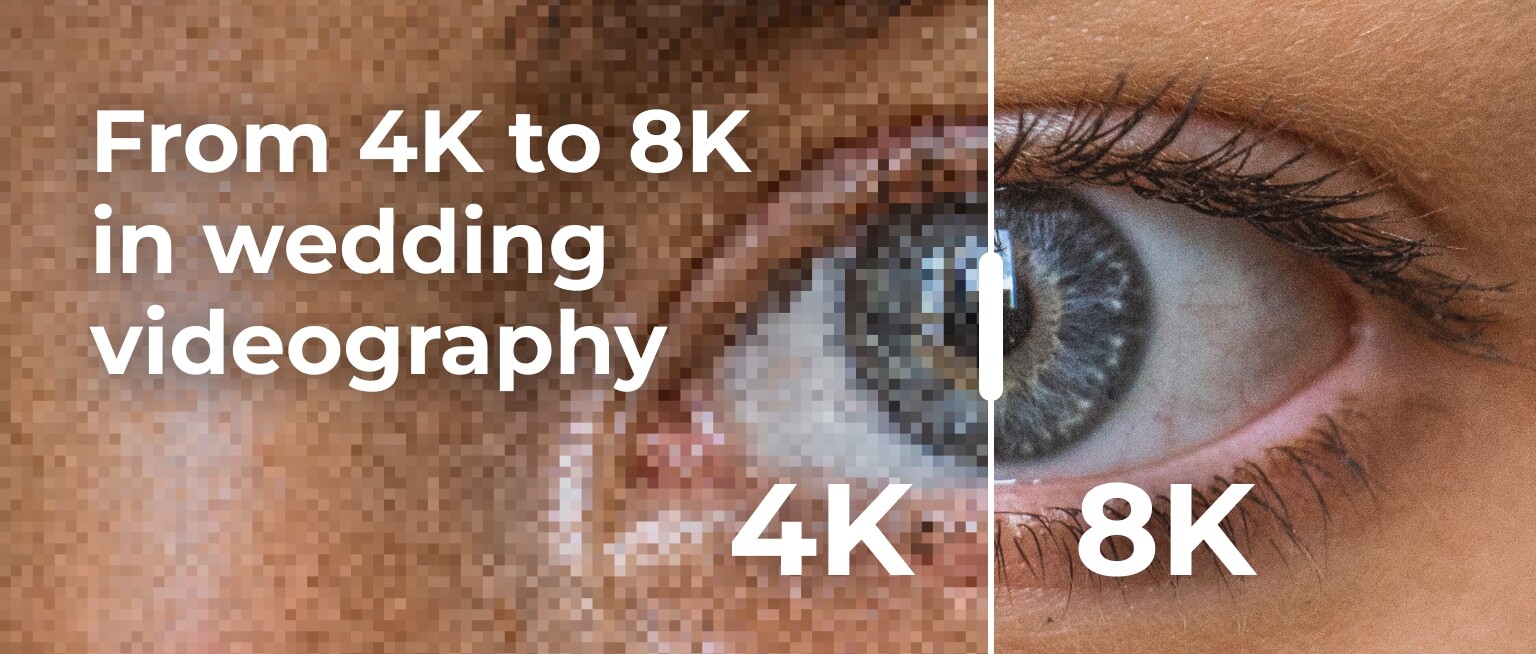
Topaz Video has been trained on thousands of videos and combines information from multiple input video shots. It can upscale almost any video up to 8K resolution with precise details and motion sequences. Topaz earns its place on the shots we can’t afford to lose: a guest’s phone clip of the first dance, footage shot in a dark reception hall, a piece from an older camera, or a moment where the focus slipped for a second. Those are the clips where the upscaling and cleanup actually pay off.
With Topaz Video it is very easy
- Turn your 360p, 480p, and 720p videos into clear footage with up to 8K resolution.
- Transfer footage from SD to HD with an impressive increase in quality.
- Restore old and noisy videos.
- Upscale computer graphics or cartoons.
- Reduce camera shake, increase video evenness, and smooth slow motion.
What’s more, this tool is easy to use. With just a few clicks, the video will start rendering to create beautiful, high-resolution footage. This is very convenient for working with the shots that have lost their quality during shooting but are necessary for the film.
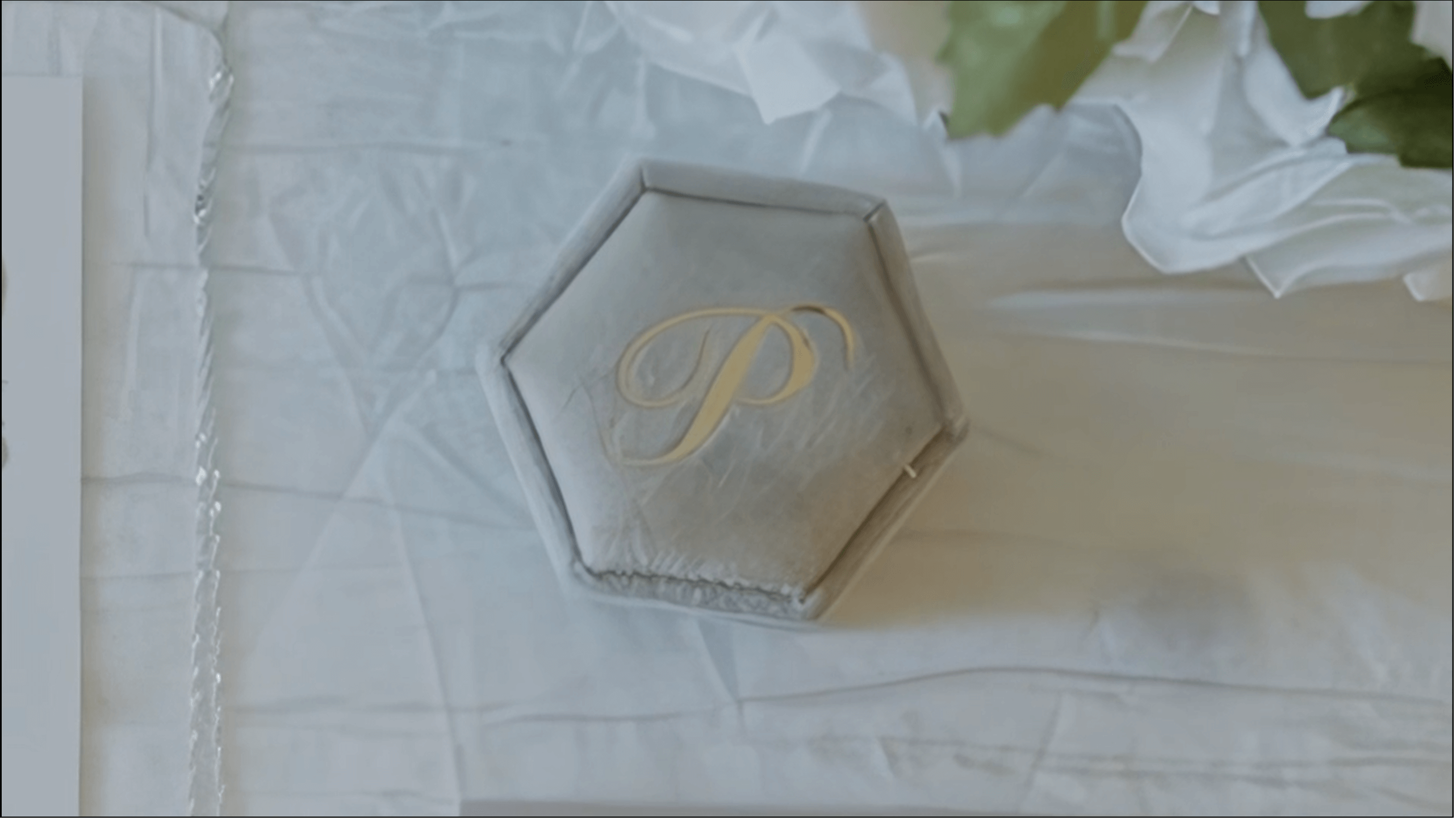
Topaz Video – What changed in 2026
The tool we started with in 2024 has changed a lot. Topaz Video AI is now simply called Topaz Video, and it now gives editors more control over problem footage: low resolution, noise, soft focus, dark shots, shaky clips, slow motion. For wedding work, we mostly use it to save footage that still matters emotionally, even if it was not shot in ideal conditions. Proteus is a good starting point for general enhancement. Iris and Nyx help with soft, compressed, or noisy footage. Starlight is useful for tougher restoration cases.
Topaz has also expanded Astra, its cloud-based video tool. Astra 2 was announced in April 2026 and is focused on stronger video upscaling.
A few of the updates matter for wedding work:
- Exports can now be paused, resumed, and managed across several projects at once. That helps a lot when a full film is exporting overnight and we need to free up the machine.
- Topaz also now works closer to editing software. There are plugins for DaVinci Resolve and After Effects, plus a Premiere Panel for sending clips from Premiere Pro to Topaz cloud processing. That cuts down on the old export-process-import routine, especially on a full wedding project.
- One thing to plan for in your season budget: since October 2025, Topaz dropped its one-time license and moved to a subscription, around $299 a year for the individual Video plan.
To learn more about the new features in Topaz Video, watch the official video:
AI plugins for working with sound
Another AI feature that we started to actively use in our workflow is for the improvement of sound.
Among different tools, we decided to try Waves Clarity Vx Pro plugin. This plugin can truly be called revolutionary as it can perform advanced noise reduction in real time. In just one pass, it can take several steps in reducing noise and, as a result, produce a clear voice and dialogues of the highest quality. It launched back in 2022 and has been our studio standard for voice cleanup ever since. It even won a Technology & Engineering Emmy in 2023 for the way its neural network pulls a voice out of the noise around it.
Another plus is that this plugin allows us to listen to the result without the need to render, bounce, duplicate, or merge tracks.
Why have we chosen Waves Clarity Vx Pro? The modern market already offers many plugins that can remove noise. However, all of them affect the voice. Only Clarity Vx Pro does not do that.
What can this plugin do?
- It removes unwanted background noise.
- It makes voices/dialogue clearer.
- It can keep ambience and remove voices.
- It can restore voices.
All video editors know that quite often the wind, the street sounds, or the voices of the surrounding people are a big hindrance. But thanks to Clarity Vx Pro, this is no longer a problem for us. It helps give us the best results in the shortest time.
For speeches recorded in big, echoey halls, we add Clarity Vx DeReverb to pull the room back out of the audio, and DeReverb Pro when the echo is heavy enough that the standard version can’t tame it. Between them, they’ve saved more than a few toasts that were almost lost to reverb.
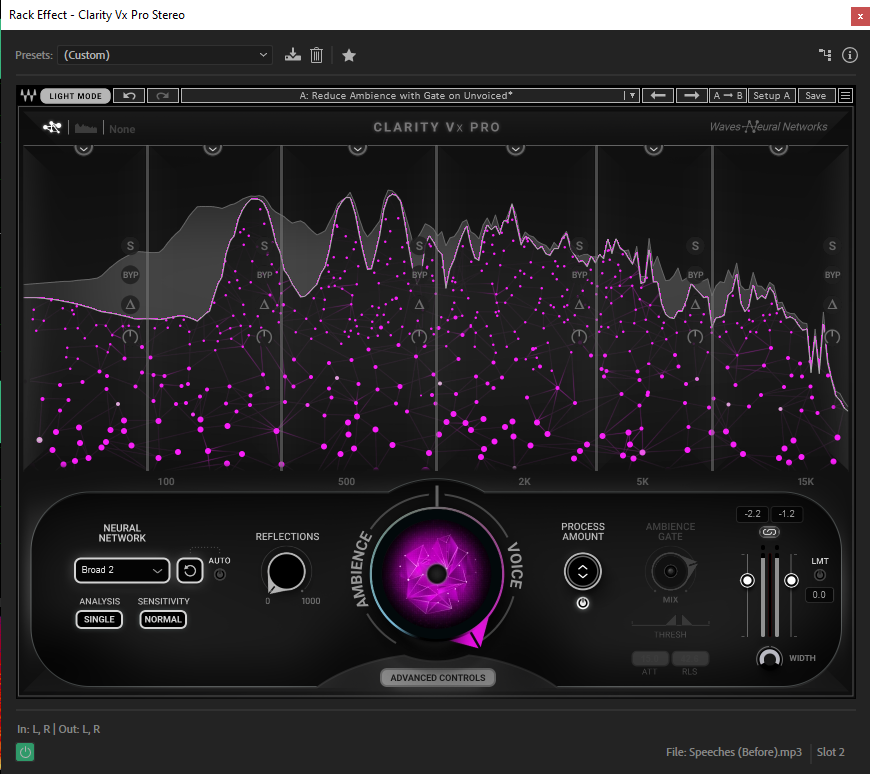
Adobe Enhance Speech
We also use Adobe Enhance Speech. It runs free in the browser through Adobe Podcast, and it’s built right into Premiere Pro through the Essential Sound panel. One pass strips out background noise and echo and brings a voice closer to a clean studio sound. It’s our go-to when audio was recorded in rough conditions, like strong wind or a loud street, or when we just need a fast fix without leaving the edit.
Auphonic
Auphonic works more like an automatic sound engineer. Instead of running live like a plugin, it takes a whole track or a full export and levels everything in one pass: it matches loudness between different speakers and normalizes to a target like -14 LUFS for YouTube. Its noise reduction also gives you separate control over noise, reverb, and breathing, so you can dial each one back on its own instead of scrubbing the whole track. We reach for it when a film has several speeches that all need to sit at the same volume, or when there’s a big batch of audio to bring in line quickly.
Conclusion
Technology is developing quite rapidly, and we always try to get the maximum benefit from our work with it. Now it’s time to start actively using AI tools and plugins. Our practice shows that this is what can greatly simplify the whole wedding video editing process already, and lots of things we used to do manually in 2023 we can now do with AI’s help. We are very excited to see what else we will be able to do with AI in a few years.
In 2026, this isn’t about keeping up with a trend anymore. AI has become part of how we work every day, mostly because it takes the technical grunt work off our plate. What it still can’t do is feel a moment or find the right rhythm in a film. That part stays with our editors. The less time we spend fixing footage and audio, the more we can put into the story.
—
FAQ
What is AI video editing?
AI video editing uses AI to handle the heavy technical work: sorting through terabytes of footage, cleaning up noisy audio, matching color, and upscaling low-res clips. It makes the process faster and the final film cleaner, while the editing decisions stay with a person.
What is the role of AI in video editing?
AI is already making a huge contribution and has many benefits for video editing. They include: footage organization, improvement of video and sound quality, restoration of old footage. In practice, AI helps most at the restoration and cleanup stage: rescuing dark or blurry shots, clearing wind and echo out of audio, and saving footage that used to be written off as a technical loss.
How does AI video upscaling work?
AI upscaling analyzes each frame, predicts the motion between frames, and rebuilds detail the original recording never captured. With a tool like Topaz Video, that can turn a 720p or SD clip into clean 4K or 8K footage without it looking fake or over-processed.
How can AI enhance a video?
AI enhancement covers a handful of separate fixes: sharpening soft footage, cutting noise from low-light shots, steadying shaky handheld clips, and cleaning up the audio. On the picture side we mostly use Topaz Video, and on the sound side Waves Clarity Vx Pro, then match the model or setting to the specific problem in the clip rather than running one filter over everything.
Can AI clean up bad wedding audio?
Yes. AI audio tools can lift a clear voice out of a noisy recording, cut wind and crowd noise, and reduce echo from a big reception hall. We use Waves Clarity Vx Pro, Adobe Enhance Speech, and Auphonic depending on the problem, so a speech that once sounded unusable can still make the final film.
Will video editing be replaced by AI?
While AI is making big changes to the editing process, it won’t be able to replace humans in the coming years. At the moment, AI can simplify video editing, making it faster and more convenient. However, all creative decisions are made only by humans. A machine doesn’t have empathy, taste, or a sense of timing, and that’s the part that makes a wedding film feel like yours.